

10 Kitchen Tools for Sensory Play You Already Own (And How to Use Them)
Children love playing with real grown-up tools. There is no replacing that feeling of using, mixing, scooping, like mom and dad do in the kitchen. For this post, I want you to take a look at your kitchen drawer. I think you will find some cool tools your children can use, and will play for hours. You can thank me later wink.
This week I pulled out the cornstarch and water with large bowls, and kept adding more kitchen tools throughout the days outside. My daughters (toddler and 6 year-old) and their friend played for hours. Yes, hours. Nothing on this blog post came from a craft store. It didn't need to.
Sensory play doesn't require a Pinterest-perfect setup or a cart full of supplies you'll use twice. The tools you already reach for every day — the ones built for pouring, scooping, mixing, and gripping — do the job just as well, often better, because they were designed with real function in mind. And that's exactly the kind of feedback growing hands and brains are looking for.
So here's the case for raiding your own kitchen, plus ten tools and simple ways to put them to work.
You can also find many of these small-sized kitchen tools at the dollar store like we did.
Why Kitchen Tools Work Better Than "Sensory Toys"
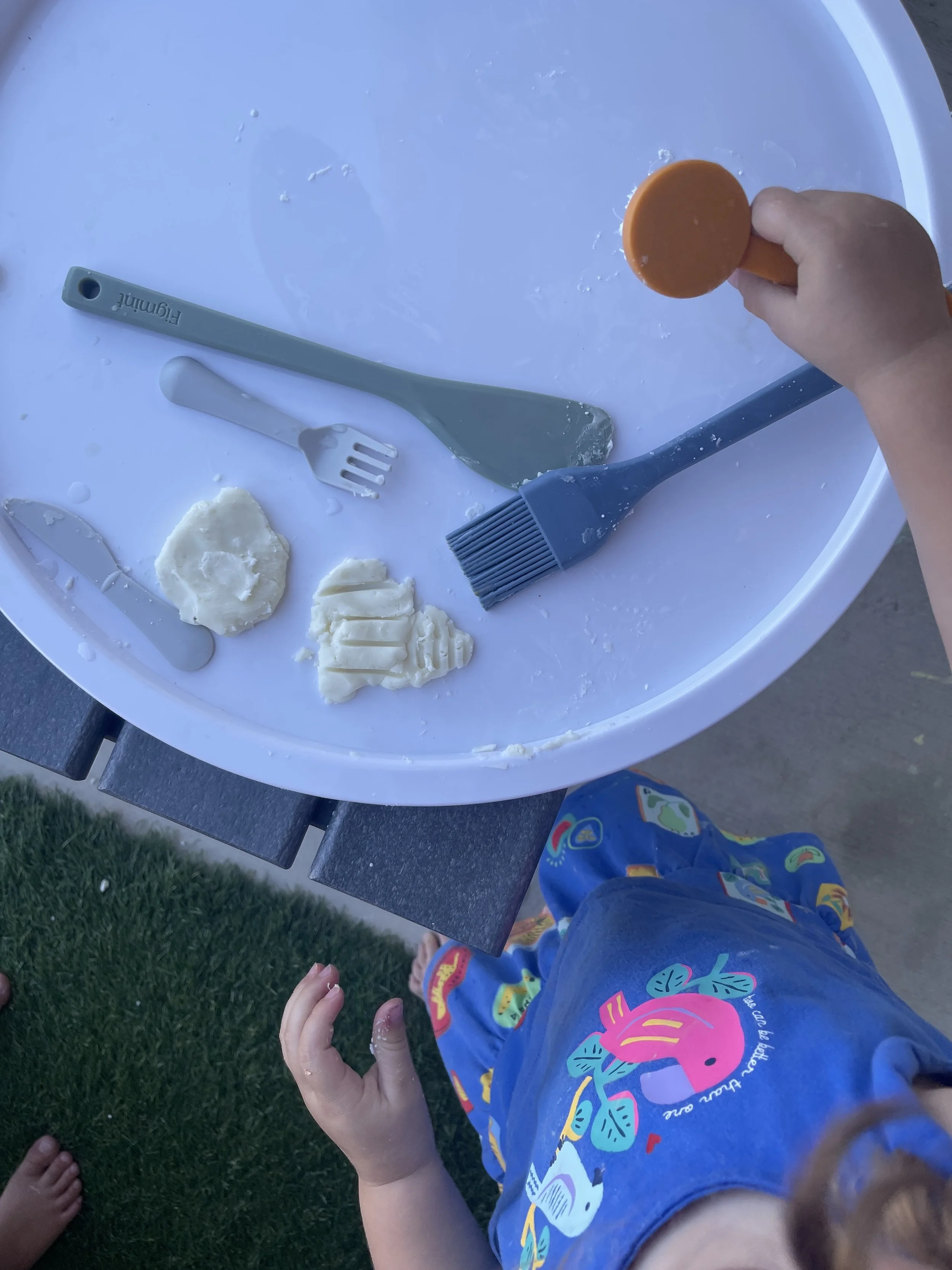
I say this as both a mom and someone who spent years in early childhood classrooms: real tools tend to out-perform toy versions of themselves, and it's not just about saving money.
A real whisk has resistance and weight. A real spatula scrapes and bends in a way a plastic toy one doesn't. That real feedback — the push-back a child feels in their hand — is doing more for their developing nervous system than a lightweight toy imitation ever could.
There's also no "right" way to use a mixing bowl. Your child can stir, bang, fill, dump, or nest it inside another bowl, and every single one of those choices is valid. That's the heart of process over product — the idea that what your child is doing matters more than what they end up with. It’s pure exploration.
This is also, not coincidentally, very Reggio Emilia. That approach to early childhood has long championed "loose parts" and real, everyday materials over commercial toys — because children build a genuine understanding of how the world works when they're handling the real thing.
The 10 Tools (And What to Do With Them)
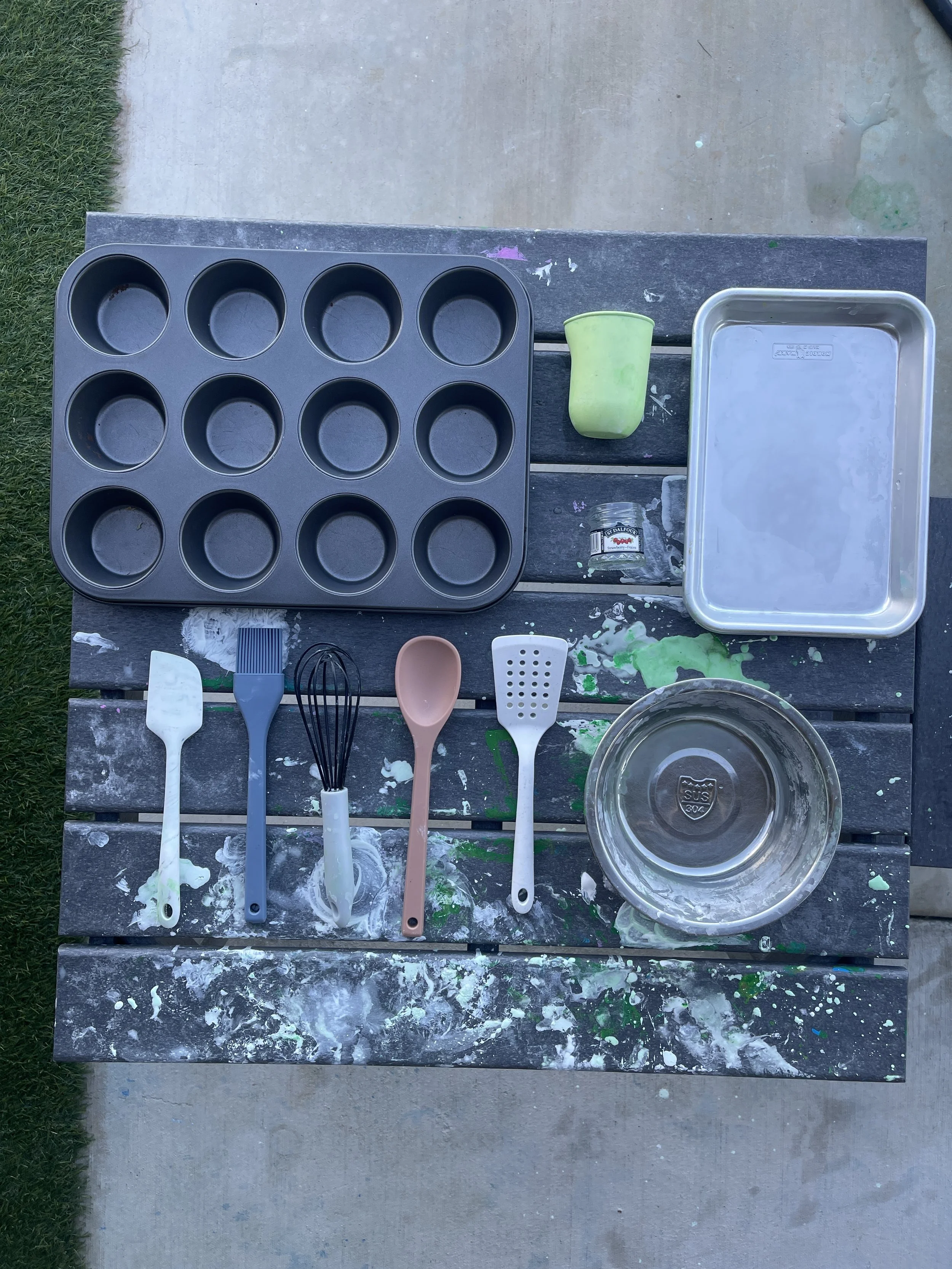
1. Muffin TinThose individual little wells are basically begging to be sorted into. Try one paint color per cup for color-mixing exploration, or fill the wells with small nature finds — pom poms, pebbles, petals — and let your child sort by color or size. It's quietly building one-to-one correspondence and early color recognition, no worksheet required.
2. Pouring CupSmall hands love small containers. Pouring paint or water from one cup to another builds hand-eye coordination and that all-important "pour slowly, then stop" control — a skill that pays off at the dinner table too.
3. Sheet Pan or Baking Tray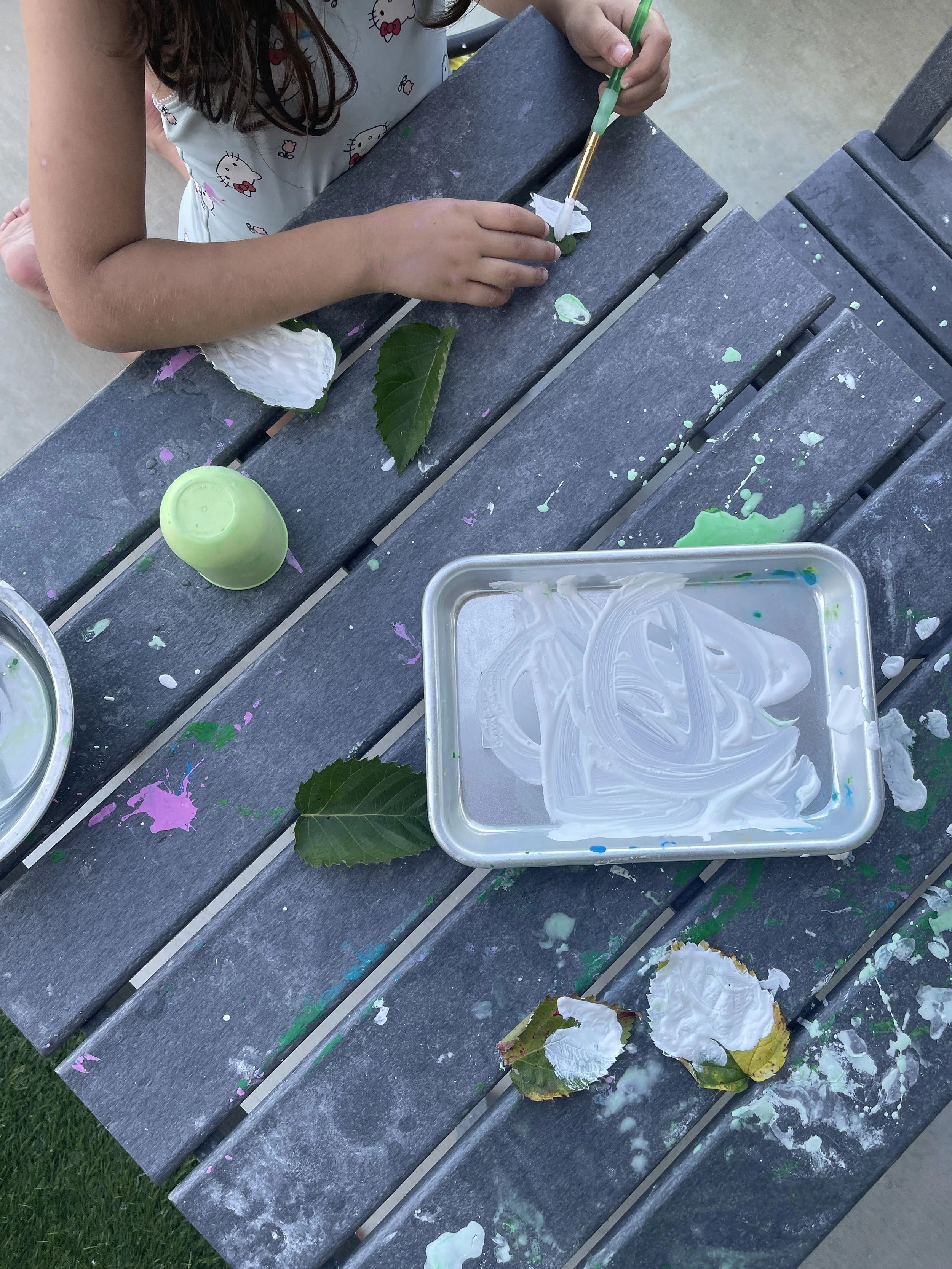
A sheet pan is the unsung hero of contained mess. And honestly my favorite. Use it as a paint palette for nature painting and mixing! Kids love mixing like little artists that they are. You can also use it as a printing surface — dip the underside of a leaf into a shallow puddle of paint and press it onto paper. Suddenly your leaf is a printmaking tool, and your child is discovering texture and pattern in something they picked up off the ground five minutes earlier.
4. A Small Jar with a LidTwisting a lid on and off works the same muscles your child needs for buttons, zippers, and eventually handwriting. Fill a jar with water and a drop of color, seal it up, and let them shake it to mix — instant, mess-contained color exploration. It also doubles beautifully as a little "treasure jar" for holding whatever they've collected outside.
5. Rubber SpatulaA spatula's whole job is scraping and spreading, which makes it perfect for textured dough or thick paint. The scraping motion works the wrist in a rotational way that's harder to replicate with a paintbrush alone, and it's oddly satisfying to watch a child fully absorbed in scraping dough from one side of a bowl to the other.
6. Basting BrushThis one surprises people. A basting brush has stiffer, coarser bristles than a paintbrush, which means it makes an entirely different mark — perfect for painting leaves, rocks, or bark. The stiffness also asks a little more of the hand holding it, working that pincer and tripod grip that eventually shows up in handwriting.
7. WhiskThere's something almost magnetic about a whisk to a young child — probably because the effect is so immediate. Whisking soap and water into foam, or stirring a paint mixture until it thickens, lets your child see and feel their own effort change something in real time. That's cause-and-effect learning at its most hands-on.
8. A Regular SpoonSimple, familiar, and doing more work than it gets credit for. Scooping and transferring with a spoon builds so much confidence and independence — every time your child spoons dough or water from one bowl to another, they're practicing the exact motion they'll use at snack time.
9. TurnerGive your child a slotted spoon and a bin of water with a few floating objects, and watch the questions start: what falls through the holes, and what stays? That's genuine early science observation, no lesson plan needed — just a tool that lets water go one way and objects go another.
10. Mixing BowlEvery mixing station needs a home base, and a sturdy metal bowl is a great one. Holding a bowl steady while working inside it engages core and shoulder stability your child doesn't even realize they're building. As a bonus, metal has a different sound and feel than plastic — one more sensory note in the mix.
Setup and Cleanup, Realistically
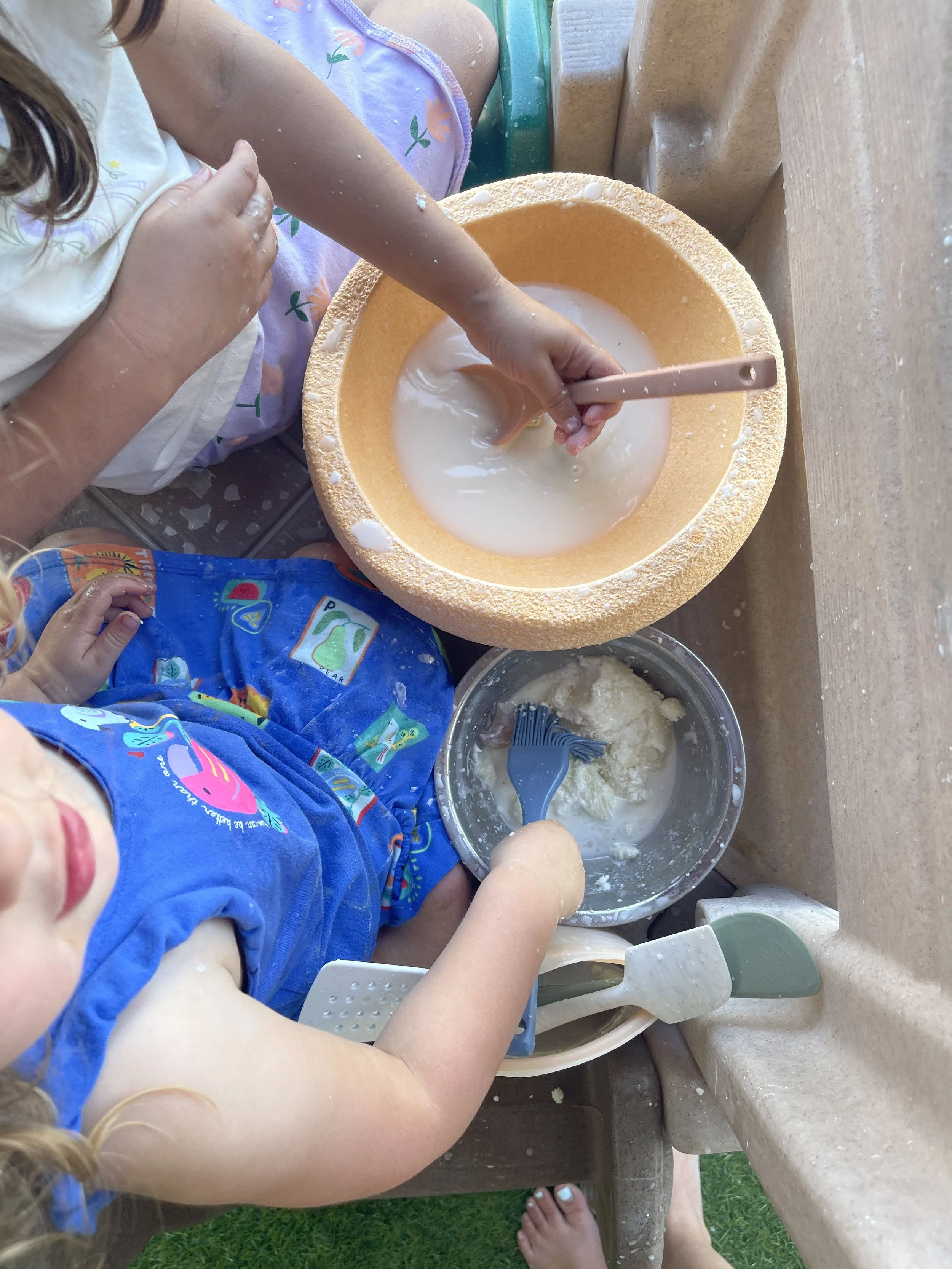
You'll notice all of my own photos are outside on the patio table, and that's not an accident. Taking sensory play outdoors means the "mess" question mostly disappears — a hose or a damp towel handles the rest. Kids bring their “paint clothes” and that’s really the only prep required.
And if I can offer one reassurance: the mess is proportional to the space you allow, not the activity itself. A sheet pan as a paint tray, a designated messy-play table, a towel underneath — small boundaries let the play stay wide open without turning into a bigger cleanup than you bargained for.
Remember friend: sensory play was never about the bin. It’s already in your home.